Developmental Edit *Purgatory*
And my complicated relationship with this stage of the novel writing process.

The Developmental Edit.
Or as I now unlovingly refer to it as: The Thinking Stage.
I crave structure. I like check lists, a manual to follow, an outline, a plan. I was excited for this stage of the process because this was the time to bring structure to my messy first draft, written in a fit of obsession. And I had a plan.
Identify the five commandments for each act.
Fix the tension and stakes.
Create a scene by scene outline.
Layer in the genre conventions and mandatory scenes.
Layer in the subplot.
Plot out the emotionality beats.
All of this was supposed to set me up for a flawless second draft. One that would lead me straight into line edits. Simple, right? Oh sweet, naive Anna, if only she knew then. It’s not nearly that simple.
I opened my first draft for its initial read through on September 22nd, 2025. Armed with my fool proof plan, I thought I’d be writing my second draft by December.
Today is January 30th, 2026. I have yet to start writing my second draft.
I have been existing in this purgatory for four months and eight days.
Month One
I began by focusing on character arcs. I didn’t want to make major changes to my plot until I understood each characters goals, needs and arcs of change. In my WIP, I have a group of five friends that each need fully fleshed out backstories, goals and needs. I spent about six weeks on character development for the group of five. This was much harder than I had anticipated. How deep did I need to dig? What parts of their history will be important to the story? Like everything else I’ve done so far, I didn’t know what I was doing. But what’s new?
Month Two
As I’ve mentioned, my first draft didn’t have enough of an antagonistic presence and the stakes were severely lacking. So month two was dedicated to fleshing out the antagonist. There were days I didn’t write a single word. Instead I spent my time talking to myself in the car, going on long walks, hoping to have something loosen in my brain. I began to feel like I was failing, like I was doing everything wrong. It had been a month of making no tangible progress. My writing routine had completely changed from the one I kept when I was drafting and I felt stalled. There are so many things to think about during this stage that my brain constantly felt either too full or too clouded. But each day I returned. Each day I pondered. Each day I moved a centimeter towards progress, until I created an entire secondary antagonistic force that fixed my conflict problem. There were things that hit me instantly. Ideas that struck like lightening. Others raised to the surface like rainwater puddling a pothole. But ultimately, it required my determination to push through The Stuck to finally unlock the secrets inside my head.
Months Three and Four
During the month of December, my focus was severely lacking, my energy was dissipating and instead of running to my desk excited, I found myself finding reasons not to even sit down. Progress was slow, to put it gently. With my characters fleshed out and my conflict realized, it was time to bring back the plot. I spent all of months three and four building the pillars of plot and testing them against various plotting techniques. I don’t necessarily recommend this. It didn’t even happen intentionally. It happened out of fear. Fear that I was doing everything wrong, fear that I was messing up, fear that I was actually making my story worse. I couldn’t see my story for what it was because I was so worried I was doing everything wrong. So I found every type of plotting technique I could get my hands on and plugged in my plot like variable in an equation, hoping it would lead me to the right answer. With every test, I kept hitting a wall. Something wasn’t working but I didn’t know what and I didn’t know how to figure out what. The story’s resistance to progression coupled with my inability to figure out why had me losing my mind a bit. But I kept testing because it kept me in control and it’s what ultimately led me to a breakthrough: I had to change my midpoint. I loved the midpoint I had drafted in my first draft but after testing the story arc through so many different plotting techniques, it started to become obvious that my current midpoint wasn’t serving the story. Once I changed the midpoint to something that worked, everything else fell in line like dominos and I was acing every test with flying colors.
This brings us to now. Today. It’s the tail end of month four and I’m finally writing out my scene by scene outline. Of the six things I planned to do, I’ve only completed three. And I will only do three before I write my second draft. In theory, I could stick to my small scene by scene outline and start layering. Maybe a more experienced, more efficient writer would. But after spending so much time on the shape, I know, instinctively, for me it’s time to draft it out completely. Layering in everything else will come in future passes.
The thinking stage is unromantic. It requires every ounce of your will power. Every cell in your brain. It’s agonizing, confusing, tear-your-hair-out infuriating. But when all that thinking leads to an aha moment, the dopamine surge will keep you on its hook, begging for more. I understand why everyone says revision is where the magic happens, where the story comes to life, because my story has taken on a whole new life. But I’d be lying if I said I was enjoying this part of the process because it’s come with a kind of hollow feeling I can only describe in one weird metaphor.
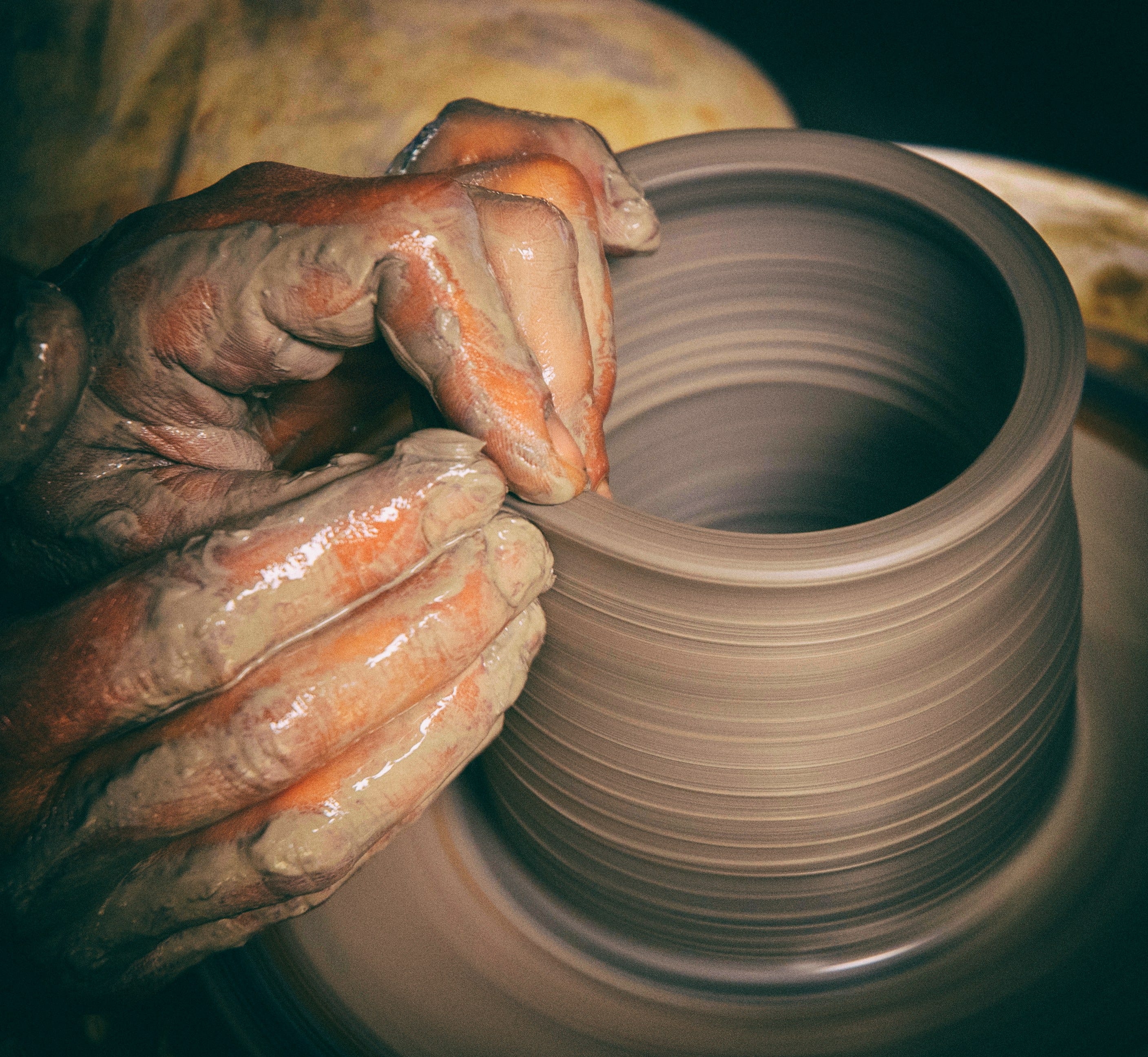
Picture your first draft as a beautifully handcrafted bowl. It’s not perfect, but it’s yours. You threw it yourself. Centering, pulling, opening and shaping the clay with your delicate fingers. The wheel spun fast as your hands caressed the wet substance into something angelic. Your very own masterpiece. You fire it in the kiln and then for six weeks, you admire the bowl from your shelf, not daring to touch it, afraid the magic might wash away if you look at it for too long. Developmental edits feel like picking up that bowl and smashing it against a concrete floor. There’s a formidable grief in those shards of dried clay broken at your feet, knowing the punishingly tedious work to come. Slowly and carefully, the pieces will fit together again, but it won’t look the same. Your masterpiece will take on a new shape, with new colors and patterns. The essence of that first angelic bowl will remain but it will be an entirely new creation, one with even more depth because it earned its imperfections.
What lesson did I glean from the last four months? Patience is mandatory and so is the unknowing. I wanted each stage of the writing process to fit neatly into a box. Something I could check off a list. First draft? Check. Developmental edits? Check. Line edits? Check. Copy Edits? Check. I wanted it to be simple, straightforward, when writing a novel is anything but. Learning to embrace the stillness, the quiet progress, the inch by inch movement in the marathon of storytelling, is pivotal. I think in some novelist version of survival of the fittest, it’s the key to adaptation.
Here’s to hoping that next week I will have finished my scene by scene outline and will be back in my happy place. Drafting.
With love,
Anna
I’m always fascinated to learn how other writers go about this weird job. Consider yourself subbed!
Like not being able to see the forest for the trees.